
















Trade global stock indices. One position. Full market exposure.

| Instrument | Sell | Buy | High (Sell) | Low (Buy) |
|---|---|---|---|---|
| Loading… | ||||
Indices trading involves speculating on the price movement of a stock market index, which represents a group of leading companies within a specific market or sector. Instead of trading individual shares, you trade the overall direction of the market – whether you expect it to rise or fall.
When trading indices with iFOREX:
You don’t own the underlying stocks
You trade price movements only
You don’t own the underlying stocks
You can go long (buy) or short (sell)
You gain exposure to broad market trends
Indices are especially popular among traders who focus on macroeconomic themes, earnings cycles, interest rates, and global risk sentiment.
Most traded indices among active traders
S&P 500 (US 500) Tracks 500 of the largest U.S. companies. Highly liquid and strongly influenced by earnings, inflation data, and Federal Reserve policy.
NASDAQ 100-Technology-heavy index known for higher volatility and strong reactions to innovation, growth expectations, and interest rate changes.
DAX 40 (Germany)-Europe’s leading index, sensitive to ECB policy, industrial data, and global trade dynamics.
FTSE 100 (UK)-Includes multinational companies with strong exposure to commodities, currencies, and global economic cycles.
These indices are widely traded because they combine liquidity, transparency, and consistent price movement – ideal for active trading with defined risk controls.
Step 1: Open an iFOREX Account
Step 2: Make a deposit or start with a demo
Step 3: Choose an index
Step 4: Decide to Buy (rise) or Sell (fall)
Step 5: Set stop-loss and take-profit levels
Regulation ensures transparency, fund protection, and responsible trading conditions.
Indices trading relies on tight spreads, especially for short-term strategies.
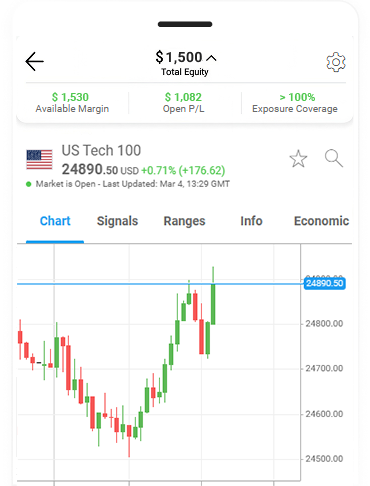
Indices move on macro news. Access to charts, signals, and economic data is critical.
Fast-moving markets require reliable, human support – when it matters.
Stop-loss tools, margin controls, and alerts help keep exposure under control.
Trading on indices uses a transparent pricing model:

The difference between buy and sell prices. Competitive spreads are essential for active indices traders.

If a position remains open overnight, a financing adjustment may apply.

Index trades on the iFOREX platform do not include additional trading commissions.
Capture broad market trends without relying on one company’s performance.
Open buy or sell positions depending on market direction.
Indices often show strong movement during London and New York trading hours.
Adjust exposure to suit your strategy and risk tolerance.
Even small market moves can have a large impact.
Interest rate decisions, inflation data, and geopolitical events can trigger volatility.
Trading multiple indices without correlation awareness can amplify risk.
Longer-term positions may incur financing charges.

Dedicated account assistance in your language.

From beginners to advanced traders, we support continuous learning.

Charts, signals, sentiment indicators, and macro insights.
An index measures the performance of a group of stocks representing a market or sector.
Yes. Trading lets you speculate on index price movements without owning stocks.
Yes. You can trade both rising and falling index markets.
Interest rates, inflation, earnings reports, economic data, and geopolitical events.
They can be, especially when combined with education, demo trading, and risk controls.
Yes. Market volatility and leverage increase risk, making risk management essential.
Access to global indices, advanced tools, human support, and a regulated trading environment.























Your IP address tells us you are visiting from an EEA member state and therefore you should go to iFOREX Europe, the trading name of iCFD Ltd., a Cyprus investment firm, which operates under EU regulations and product intervention rules.
Please choose: